
- Updates
- News
A UNESCO Creative Cities Network Salon in Quanzhou Explores Cross-City Synergies
QUANZHOU, China — What new possibilities emerge when the culinary vitality of a City of Gastronomy intersects with the rhythm of a City of Music, the innovation of a City of Design, or the craftsmanship of a City of Crafts and Folk Art? This question anchored a recent UNESCO Creative Cities Network (UCCN) cultural salon held in Quanzhou, one of China's newest members of the network.
Held under the theme "Creative Integration: Flavours Connecting the World," the Citong Dialogue salon convened representatives from eight Chinese UNESCO Creative Cities—Macao, Chengdu, Yangzhou, Huai'an, Wuxi, Jingdezhen, Wuhan, and host city Quanzhou. The event enabled a rare cross-sector exchange on creativity as a driver of sustainable urban development, offering the newly designated City of Gastronomy valuable peer insights and practical guidance.
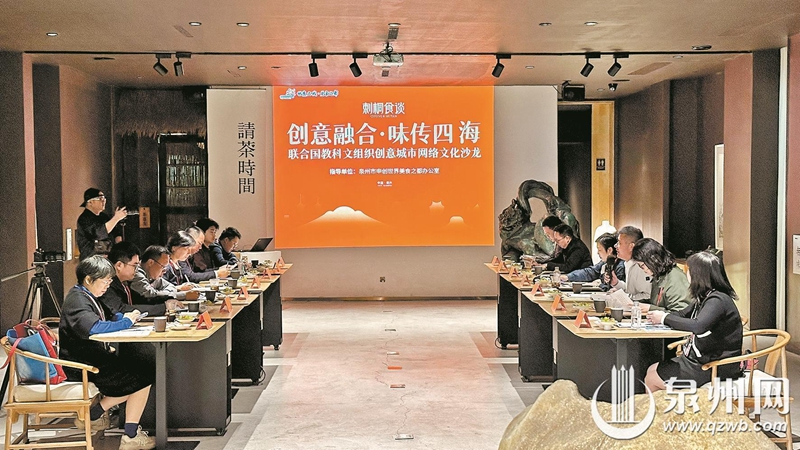
Delegates from Chinese UNESCO Creative Cities engage in dialogue on "Creativity as a Driver of Sustainable Urban Development" at the UNESCO Creative Cities Network salon in Quanzhou.
(Image source: WeChat public account "The Taste of Quanzhou")
Part I: Shared Pathways — How Creative Cities Activate Their Potential
"Quanzhou is a newcomer to the UNESCO Creative Cities Network, and we are eager to learn from cities with longer experience," said Xiao Zhaohui, Executive Deputy Director of Quanzhou's UNESCO City of Gastronomy Application Office, in his opening remarks—setting the tone for candid knowledge-sharing.
City representatives outlined diverse strategies for leveraging their UNESCO designations:
·Macao (Gastronomy):
"The UNESCO title has provided strong momentum for promoting Macanese cuisine," said Ma Yuling, Director of Organisation, Planning and Development at the Macao Government Tourism Office. She highlighted gastronomy as a platform for cross-regional collaboration and tourism growth.
·Chengdu (Gastronomy):
Since joining the network in 2010, Chengdu has significantly elevated the global profile of Sichuan cuisine. Huang Jian, Deputy Director of the Chengdu Commerce Bureau, noted that the city's annual catering revenue now exceeds 100 billion yuan. Food festivals, digital platforms, and curated recognition of chefs and neighbourhood eateries have helped turn gastronomy into a year-round urban celebration.
·Yangzhou (Gastronomy):
Guo Yuntao, Deputy Director of the Yangzhou Commerce Bureau, presented an "education + industry" model, encompassing vocational training, postgraduate programmes, and public weekend cooking courses. The city is also developing a food industry park with central kitchens serving local restaurant chains.
·Huai'an (Gastronomy):
Tian Sen, Deputy Director of the Huai'an International Investment Promotion Centre, introduced an innovative "One Product, One Book, One Song, One Play" approach. By integrating cuisine with literature, music, and theatre, Huai'an has extended Huaiyang cuisine into the cultural and digital spheres, achieving notable public engagement.
Part II: Cross-Creative Fusion — Seeking the "Chemical Reaction"
The discussion then expanded beyond gastronomy to explore intersections with other creative fields.
·Jingdezhen (Crafts and Folk Art):
"Imagine Quanzhou seafood served on Jingdezhen blue-and-white porcelain," proposed Peng Xiongyue, Deputy Director of the Jingdezhen Ceramic Culture Centre. He suggested joint cultural tourism projects that integrate culinary and ceramic heritage, evoking the shared aesthetics of the Song and Yuan dynasties.
·Wuxi (Music):
Designated a City of Music in 2025, Wuxi launched an interactive Music Map that links digital users to music venues and events across the city. According to Zhu Ying, Deputy Director of Wuxi's Municipal Publicity Department, the platform attracted over 120 million online interactions within two weeks. The city is now exploring models such as "Music + Homestays," "Music + Intangible Cultural Heritage," and "Music + Gastronomy."
·Wuhan (Design):
Dong Fei, Director of the International Cooperation and Exchange Institute at the Wuhan Planning and Design Institute, described how Wuhan's City of Design designation has supported initiatives in historic district renewal and creative placemaking. Under the 2025 theme "Vibrant River City," designers nationwide are invited to reimagine urban spaces rooted in everyday street life.
Part III: Toward a Chinese Creative Cities Alliance
The most forward-looking proposal came from the host city. Chen Xiang, Deputy Head of Quanzhou's Application Office, called on Chinese UNESCO Creative Cities to establish a national alliance for coordinated development.
He outlined practical forms of cooperation: Quanzhou's food festivals could host partner gastronomy cities, Wuhan could contribute design expertise, and Wuxi could curate musical programming. Joint international promotions, he suggested, would allow Chinese creative cities to "present a collective presence on the global stage and amplify China's creative voice."
The salon marked a shift from isolated case studies toward structured collaboration, pointing to a future in which gastronomy, music, design, and craft function not as separate labels, but as interconnected engines of sustainable urban innovation.
By Chen Linghong, Integrated Media Reporter
 Return List