
- Updates
- News
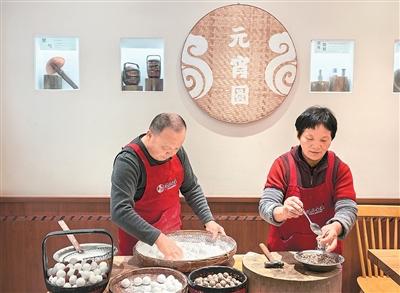
Lin Yongsong's parents making traditional yuanxiao (glutinous rice balls).
Photo courtesy of the interviewee.
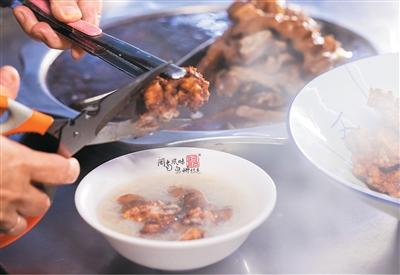
A bowl of Quanzhou's signature mianxian hu (Misua soup).
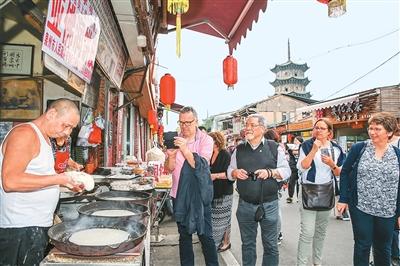
Foreign visitors watching the preparation of runbing (spring rolls) on a Quanzhou street.
In China's newest UNESCO City of Gastronomy, history is not only preserved in monuments and archives, but tasted— in a bowl of noodle soup, a freshly rolled spring roll, and the shared rituals of everyday kitchens.
QUANZHOU, China — In the narrow streets of this ancient port city, culinary alchemy unfolds daily. Hair-thin Misua soup (mianxian hu) melt into a rich broth, layered with crispy fried pork, tofu, crullers, and plump oysters to form a comforting bowl of mianxian hu. Nearby, a deft pair of hands spreads a paper-thin crepe, filling it with shredded turnip, celery, bean sprouts, pork belly, oysters, shrimp, crushed peanuts, seaweed, and a touch of sugar before rolling it into the iconic runbing (spring roll). A few steps away, adventurous diners sample tusundong—a savoury jelly made from marine worms—valued for its clean, subtly sweet flavour.
This sensory landscape defines Quanzhou, a historic hub of the Maritime Silk Road. In 2025, the city was admitted to UNESCO's Creative Cities Network as a City of Gastronomy, becoming the seventh Chinese city to receive the designation. The title recognises not a static culinary legacy, but a living food culture shaped by over a thousand years of global exchange.
The Everyday Wisdom of the Home Kitchen
"Quanzhou cuisine is not about rare ingredients or elaborate presentation," says Lin Jianqiang, president of the Licheng Historical Society and a specialist in local food culture. "Its beauty lies in using local produce wisely and fully. It belongs as much to family tables and street stalls as it does to restaurants."
This philosophy is exemplified by jiangmuya—ginger-braised duck. On Tumen Street, the popular Sidan Jiangmuya shop hums with activity as rows of clay pots simmer, releasing the deep aroma of aged duck, old ginger, and sesame oil. According to municipal data, more than 10,000 ducks are sold daily across Quanzhou, rising to 25,000–30,000 during holidays, with an annual industry value exceeding 500 million yuan.
To trace the roots of such everyday dishes, Lin has launched a project titled Tracing Flavours through the Classics, combing historical texts, literary works, letters, and local gazetteers. His research reveals that runbing dates back to the Qing dynasty and originated from post-ritual meals. "After sacrificial ceremonies, the offerings had cooled and were unpalatable if eaten cold," Lin explains. "People reheated the ingredients together, creating a distinctive 'mixed dish'." Heat releases the sweetness of turnip, blending it with peanuts, sugar, and seaweed to produce a layered, balanced flavour.
A Port City's Taste for Openness
Quanzhou's defining culinary trait is fusion rooted in openness. During the Song and Yuan dynasties, it was one of the world's busiest ports, where merchants introduced spices, ingredients, and cooking practices from across Asia and beyond.
"Foreign elements were absorbed, never allowed to dominate," Lin notes. "It's a cooking wisdom of enhancing flavour without overshadowing the original taste." Pepper—once an import—cuts the fishiness of seafood; cinnamon subtly enriches ginger-braised duck; sweet potatoes from the New World were transformed into starch for dishes such as meat soup and oyster omelettes; and Southeast Asian curry techniques were adapted into milder, aromatic beef dishes.
Flavours Passed Down Through Generations
This culinary heritage lives on in family traditions. In Jinyu Lane, 36-year-old Lin Yongsong, the fourth-generation heir of Maritime Silk Golden Phoenix, prepares yuanxiao—glutinous rice balls filled with peanuts, sesame, sugar, scallions, and pork fat. The process appears simple but is exacting: water content, temperature, and humidity all affect whether the delicate balls hold their shape.
Lin's parents opened the shop in the 1990s. "Yuanxiao tastes like home," he recalls. After returning from university, Lin inherited the craft, adjusting sweetness levels for modern tastes while expanding the menu to include peanut soup, tofu pudding, and other traditional snacks. Today, the shop sells hundreds of thousands of yuanxiao annually, serving up to 2,000 customers a day during festival peaks.
For Quanzhou's global diaspora—nearly 9.5 million people across 130 countries—such foods carry powerful emotional resonance. Lin has taken yuanxiao abroad for culinary exchanges in the Philippines, Hungary, and Serbia. "Each piece carries the taste of home," he says.
Innovation Through Exchange
On West Street, tradition and experimentation coexist. Alongside stalls selling tusundong, taro cakes, manjian gao, rice dumplings, and mianxian hu, diners can also find fusion creations such as "ginger-braised duck pizza," where rich braised duck meets melted cheese—an unexpected pairing that has won over curious visitors.
"Quanzhou's food culture has always been shaped by overseas exchange," says Liu Shuwen, president of the Quanzhou Catering Association. Following the UNESCO designation, the association issued a self-regulation pledge against arbitrary price hikes and declining standards. To date, 113 standards covering ingredients, techniques, and service have been established.
Looking ahead, an immersive Quanzhou Food Museum is under construction, and new high-standard food streets are planned across the city's districts. According to Xiao Zhaohui, executive deputy director of Quanzhou's UNESCO application office, a four-year development plan is underway. "We will continue to strengthen Quanzhou's dual identity as a World Heritage City and a City of Gastronomy," he says, "offering visitors rich, diverse, and distinctly local experiences."
In Quanzhou, every meal tells a story—of the sea, of home, and of a city that has been trading, tasting, and transforming global influences for more than a millennium.
(By Shi Yu. Photographs by Chen Yingjie unless otherwise noted. Originally published in People's Daily Overseas Edition.)
 Return List